





Alright. Let's be real here. You are over forty. You have been thinking about this for a while. Maybe years. You see people at the gym. You see before and after pictures online. You think "I should do that."
But you do not.
Why?
Because it feels like too much. Too much equipment. Too much knowledge you do not have. Too much risk of looking stupid or getting hurt.
I get it. I really do.
Here is what nobody tells you. Most of those people at the gym have no idea what they are doing either. They are just moving weight around without much thought. They learned from YouTube. They learned from a friend who also learned from YouTube. They are not experts. You do not need to be an expert either. You just need to start.
What Happens When You Turn 40?

Your body changes. You already know this.
You wake up and things hurt that did not hurt before. Your back. Your knees. Your shoulders. You move wrong and something pulls. You sit too long and you get stiff.
That is not aging. That is disuse.
Your muscles are shrinking. Slowly. Quietly. You do not notice it day to day. But over years it adds up. By the time you are sixty, you might have lost a third of your muscle mass.
A third.
That is a lot.
When you lose muscle, you lose strength. You lose balance. You lose the ability to do things you take for granted right now.
Carrying groceries. Playing with your kids or grandkids. Getting off the floor if you fall.
All of that becomes harder.
Strength training stops that. It actually reverses it. You can get muscle back at any age. Science has proven this over and over.
So why are you waiting?
Read Also: Top 10 Balance Exercises For Seniors At Home
The Dumbest Mistake You Can Make
People start training after forty and they do the same stupid thing.
They go too hard.
They walk into the gym feeling motivated. They lift weights that are too heavy. They do too many exercises. They push themselves until they are exhausted.
Then they cannot move for three days.
They are so sore they cannot sleep. They walk funny. They complain to their friends about how much pain they are in.
And then they never go back.
I have seen this happen so many times. It is painful to watch because it is so avoidable.
You are not twenty anymore. Your body does not recover the same way. The inflammation stays longer. The soreness lasts longer. The risk of injury is higher.
So do not train like you are twenty.
Train like you are forty. That means smart. That means patient. That means leaving the gym feeling like you could have done a little more.
That feeling is not weakness. That is strategy.
The Other Mistake That Gets You Hurt
Bad form.
This one is sneaky. You do an exercise wrong and it feels fine. You do it again. Still fine. Weeks go by. Months maybe.
Then one day you wake up and your shoulder is killing you. Or your lower back is shot. You have no idea what happened.
What happened is that you were doing the exercise wrong the whole time. The stress built up slowly. Your joints and tendons took the damage instead of your muscles. Eventually they gave out.
This is why coaching matters.
I know. You do not want to pay a trainer. You think you can figure it out from videos.
You cannot.
Videos cannot see you. They cannot correct you in real time. They cannot tell you that your back is rounding or your knees are caving in.
A coach can.
Even three sessions with a good coach will save you months of pain and frustration. They will teach you how to move safely. They will give you feedback that no video can provide.
If you cannot afford a coach, find a friend who has been lifting for years. Ask them to watch you. Ask them to be honest with you.
It is worth the embarrassment.
What You Actually Need To Do?
Here is the simple version.
- Two days a week. That is it. Not five days. Not six. Two.
- Each session takes about forty five minutes. Warm up for five. Train for thirty five. Cool down for five.
- You do six exercises. Squat, hinge, push, pull, core, carry. That covers everything. Your whole body gets trained each time.
- You pick a weight that feels manageable. Not heavy. Manageable. The last two reps should take some effort. If you finish easily, go heavier next week. If you struggle, go lighter.
- That is the whole plan.
- Nothing complicated. Nothing fancy. Just showing up twice a week and doing the work.
What Week One Looks Like?
Monday you train. Wednesday you train. The rest of the week you rest or walk.
That is it.
Do that for a month. Write down what you did each session. How much weight. How many reps. How it felt.
Do not skip the writing part. You will forget. We all forget. Write it down so you know where to start next time.
Home Gym or Real Gym
You can do this anywhere.
At home you need dumbbells, a bench, and a band. That costs maybe a hundred bucks. Less if you buy used. You save time because you do not have to drive anywhere.
At the gym you get more equipment and more space. You also get people around you. Some people like that. Some do not.
The real advantage of a gym is the coaching. If you join a place that offers small group training, you get guidance without paying for private sessions.
Choose what works for you. Both options are fine.
What The First Few Weeks Feel Like?
Honestly? They feel weird.
You might not feel like you are doing anything. The weights feel light. The sessions feel short. You wonder if you are wasting your time.
You are not.
In the beginning, your body is learning. It is figuring out how to coordinate movement. That happens before muscle growth happens. It takes time.
Some soreness is normal. Extreme soreness is not. If you are crippled the next day, you did too much. Back off.
You May Also Like: Best Stretching Exercises for Stiff Body
A Story To Prove It Works
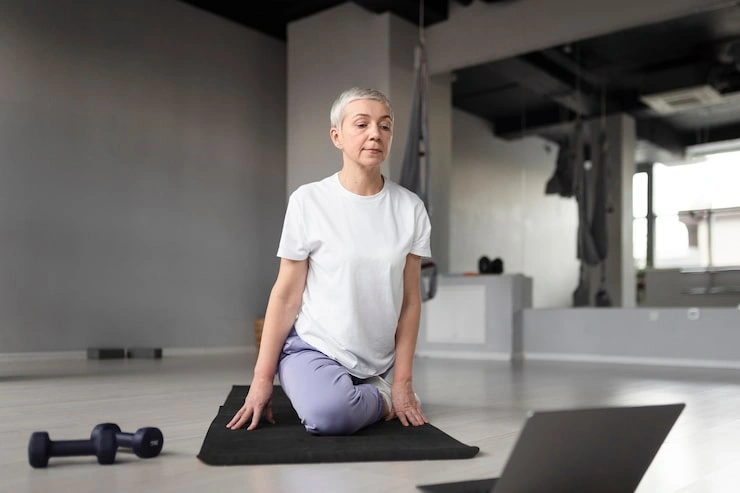
- There is a woman named Andrea. She started training at sixty. Sixty. Never lifted a weight in her life.
- She was nervous. She felt old and out of place. She thought everyone would stare.
- Her coach started her slow. Light weights. Simple movements. Twice a week.
- Three weeks later she felt comfortable. The nerves were gone.
- Six months later she was lifting weights she never thought possible. She felt strong. She felt capable. She felt like a different person.
- This is not a miracle. This is what happens when you stick with something.
Questions People Always Ask
Can I really build muscle at forty five?
Yes. Your body responds. Slower than before but it responds.
How long until I see changes?
Strength in weeks. Appearance in months. Be patient.
What if I have a bad back?
See a doctor first. A good coach can work around almost anything.
Do I need to eat differently?
Protein helps. But do not change everything at once. Focus on the training first.
Conclusion
That is the whole message here. You do not need a perfect plan. You do not need to know everything. You do not need to be in great shape already. You just need to start. Start with two sessions a week. Start with light weights. Start with simple exercises. The first month is about building the habit. It is about showing up even when you do not feel like it. It is about proving to yourself that you can do this. After that, everything gets easier. Your body will adapt. You will get stronger. The weights that felt heavy will feel light. The sessions that felt strange will feel normal. It happens to everyone who sticks with it. So stop thinking about it. Stop researching. Stop waiting for the perfect time. The perfect time is now. Go pick up something heavy. Put it down. Do it again.