



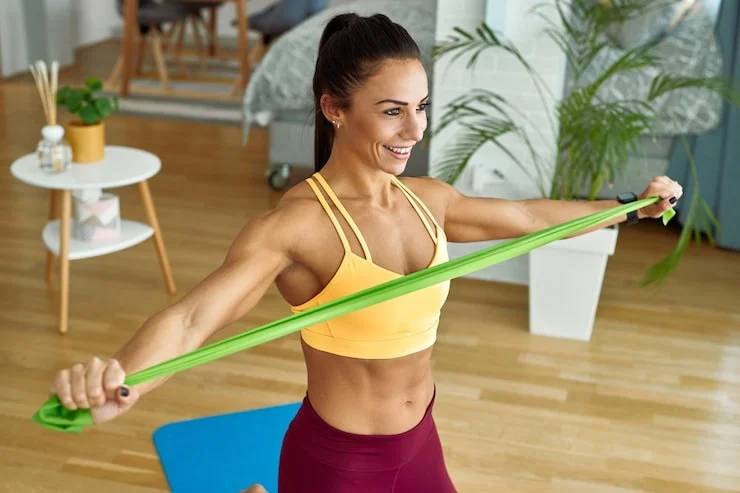
If you are new to resistance bands, start with a set of light to medium bands (10–20 pounds of resistance), learn five to six basic movements that cover your upper body, lower body, and core, and practice them two to three times per week with slow, controlled form. You do not need a gym, a trainer, or heavy weights to see real progress. A single band and twenty minutes are enough to begin.
This guide walks you through everything a beginner needs to know: how to pick your first band, how to stay safe, which exercises actually matter, and how to put them together into a simple routine you can resistance band exercises for beginners.
Why Resistance Bands Work Well for Beginners?
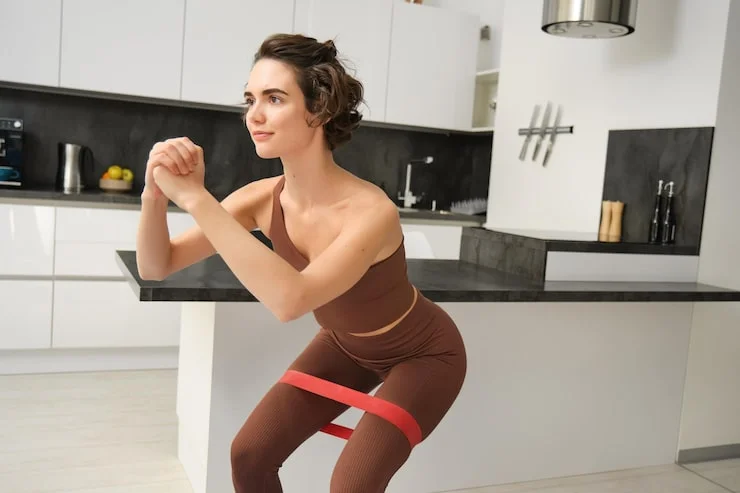
Resistance bands offer something that free weights often cannot: a gentle, adjustable form of resistance that meets you exactly where you are. When you pull a band, the tension increases the further you stretch it . This means the hardest part of the movement comes at the end of your range, where your muscles are already warmed into the motion. For a beginner, this feels more forgiving than a dumbbell that feels equally heavy from the first inch to the last.
Bands are also quiet, portable, and inexpensive. You can keep a set in a drawer and use them while watching television or waiting for water to boil. That ease of access matters more than most people admit. The best exercise program is the one you actually do, and bands remove nearly every excuse.
One more thing: bands train stability, not just strength. Because the band pulls from an angle rather than straight down like gravity, your smaller muscles around the joints have to work to keep the movement clean . For a beginner, that means you are building coordination alongside raw strength, which pays off later when you move on to heavier weights or more complex movements.
Read Also: Top 10 Balance Exercises For Seniors At Home
Choosing Your First Band: What Actually Matters
Walk into any sporting goods store or scroll through an online shop, and you will see bands in every color, length, and shape. It is easy to overthink this. Here is the simple version.
For your first purchase, look for a long loop band or a flat band with a light to medium resistance rating. Many brands label bands by color, but the colors are not standardized across companies. Ignore the color and look for a resistance range printed on the packaging. A band rated somewhere between ten and twenty pounds of resistance is a sensible starting point for most beginners .
If you can afford a set with three levels (light, medium, heavy), buy the set. You will likely outgrow the light band within a few weeks for lower-body exercises, but it will remain useful for smaller upper-body movements like shoulder rotations and triceps work.
Mini bands (the short loops that fit around your thighs or ankles) are excellent for glute activation and lateral movements. Long bands with handles are convenient for rows and presses because the handles are easy to grip, but they are not necessary. A plain flat band can be knotted or looped to serve the same purpose.
Skip the very thin, very stretchy therapy bands for strength training. They are designed for rehabilitation and gentle stretching, not for loading your muscles. You want a band that feels substantial in your hands, with a thickness that resists easy stretching.
Safety Rules Every Beginner Should Know
Resistance bands are not dangerous, but they can snap if mistreated, and a snapping band can sting. A few habits will keep you safe.
Inspect your band before every session. Run your fingers along the length of the band and look for nicks, tears, or cloudy spots where the rubber has worn thin. A damaged band is a band waiting to break. Replace it rather than risk it .
Anchor with care. If you are using a door anchor, make sure the door is closed and locked and that the anchor is placed on the hinge side, not the handle side. If you are looping the band around a pole or furniture leg, tug it firmly before you start to confirm it will not slip. Never anchor a band to something sharp, unstable, or likely to move .
Do not overstretch the band. Every band has a limit. If you stretch it so far that it feels thin and rigid, you are shortening its life and risking a break. Choose a band light enough that you can complete your repetitions without maxing out the stretch .
Move slowly, especially on the return. The most common mistake beginners make is letting the band snap back. That return phase, called the eccentric portion, is where a lot of the strength-building happens. Control it. If you cannot control the return, the band is too heavy .
The Exercises: A Beginner’s Foundation
You do not need thirty exercises. You need a handful that cover the major movement patterns: a push, a pull, a squat, a hinge, a core movement, and something for the shoulders or hips. The six exercises below form a complete foundation. Learn them well before adding more.
Banded Squat
Stand with your feet shoulder-width apart, standing on the middle of your band with both feet. Hold the ends of the band at shoulder height with your elbows bent. Keep your chest tall and your weight in your heels. Lower your hips back and down as if sitting into a chair, going only as deep as you can while keeping your back straight. Push through your feet to stand, squeezing your glutes at the top .
This teaches the same pattern as a bodyweight squat or a barbell squat, but the band adds resistance at the top of the movement, where your hips are strongest. If the band pulls you forward or feels awkward, step closer to the middle of the band to reduce tension.
Banded Row
Sit on the floor with your legs extended in front of you. Loop the band around the soles of your feet and hold one end in each hand. Sit tall with a straight spine. Pull the handles toward your lower ribs, squeezing your shoulder blades together as if pinching a pencil between them. Pause for a moment, then slowly extend your arms back to the start .
This is one of the most valuable exercises for beginners because it strengthens the muscles between and below the shoulder blades, which most people neglect. If you spend hours at a desk or looking at a phone, this movement counters the rounded-forward posture that develops over time.
Banded Glute Bridge
Lie on your back with your knees bent and feet flat on the floor, hip-width apart. Place a mini band just above your knees, or loop a long band around your thighs. Press your feet into the floor and lift your hips toward the ceiling until your body forms a straight line from shoulders to knees. Push gently outward against the band as you lift so your knees do not collapse inward. Lower with control .
The glutes are the largest muscles in your body, and they respond well to this kind of direct work. For a beginner, the bridge is safer and easier to feel than a complicated standing movement. Once it feels easy, you can progress to single-leg bridges or add a longer pause at the top.
Banded Chest Press
Anchor your band at chest height behind you—a door anchor works well here, or you can loop the band around a sturdy pole. Face away from the anchor, hold one end in each hand, and step forward until there is tension in the band. Bring your hands to your chest with your elbows bent and tucked at roughly forty-five degrees from your body. Press your hands forward until your arms are extended, then slowly return to the start .
The key here is the setup. If the band feels slack at the start, step further forward. If it feels too heavy to control, step closer. The press itself should feel smooth, not jerky.
Banded Deadlift
Stand on the middle of your band with your feet hip-width apart. Hold the ends in both hands in front of your thighs. With a slight bend in your knees, push your hips back as if closing a car door with your rear end. Let your hands slide down the front of your legs as your torso leans forward, keeping your back flat. When you feel a stretch in the back of your thighs, drive your hips forward to stand tall .
This movement teaches the hip hinge, which is the foundation of lifting anything safely—groceries, a suitcase, a child. Beginners often squat when they should hinge, so practicing this pattern with a light band pays dividends in daily life.
Banded Pallof Press (Core)
Anchor your band at chest height. Stand sideways to the anchor and hold the band with both hands at your chest. Step away until there is tension. Press your hands straight out in front of you, resisting the band’s pull to rotate your torso toward the anchor. Hold for a second, then bring your hands back to your chest .
This is a core exercise that trains your body to resist twisting, which is more useful in real life than doing hundreds of sit-ups. Beginners often feel this in their obliques and lower back, which is exactly the resistance band exercises for beginners.
You May Also Like: How To Build Muscle Without Gaining Fat
Putting It Together: A Simple Beginner Routine

Do this routine two or three times per week on non-consecutive days. Give yourself at least one full day of rest between sessions so your muscles can recover.
Warm-up (3–4 minutes): March in place, circle your arms, do a few bodyweight squats, and gently stretch your shoulders and hips.
The workout: Perform the exercises in the order listed. For each exercise, do two sets of ten to fifteen repetitions. Rest for about thirty to sixty seconds between sets.
- Banded Squat — 2 sets of 10–15
- Banded Row — 2 sets of 10–15
- Banded Glute Bridge — 2 sets of 12–15
- Banded Chest Press — 2 sets of 10–12
- Banded Deadlift — 2 sets of 10–12
- Banded Pallof Press — 2 sets of 8–10 per side
The entire session should take roughly twenty minutes. If you finish and feel like you could do another round easily, the band is too light or you need more repetitions. If you finish and feel completely drained or your form fell apart in the last few reps, the band is too heavy. The right level of challenge is somewhere in the middle—challenging enough that the last two or three reps of each set feel genuinely difficult, but not so hard that you lose control .
Common Mistakes to Leave Behind
Going too heavy too soon. A band that feels easy in the store can feel very different after ten repetitions. Start lighter than you think you need. You can always add resistance next week .
Rushing the movement. Slow down. Bands are not meant to be yanked. Each repetition should take a few seconds on the way out and a few seconds on the way back. If you are moving fast enough that the band makes a snapping sound, you are using momentum instead of muscle .
Holding your breath. Breathe out as you exert force, breathe in as you return. This sounds obvious, but beginners often hold their breath without realizing it, which makes the whole thing feel harder than it needs to be.
Ignoring the setup. A band that slips off your foot or pulls your anchor loose mid-set is a distraction at best and an injury risk at worst. Take thirty extra seconds to set up properly before every exercise .
Frequently Asked Questions
How long before I see results?
Most beginners notice that movements feel easier within two to three weeks. Visible changes in muscle tone typically take six to eight weeks of consistent practice. The key word is consistent. Two short sessions every week will do more than one long session every ten days.
Can I build real muscle with bands?
Yes, especially as a beginner. Bands provide progressive resistance—the more you stretch them, the harder they pull. As you get stronger, you use thicker bands or step further from the anchor. For beginners, the stimulus is more than enough to build a foundation of strength .
What if I only have one band?
You can still do this entire routine. Adjust the difficulty by changing your body position. For a squat, stand on the band with your feet closer together for more tension or wider apart for less. For a row, sit further from your feet. Small changes in leverage make a big difference.
Should I do cardio too?
Yes, if you can. Resistance bands build strength, but your heart and lungs need their own work. Walking, cycling, or any activity that raises your heart rate for twenty to thirty minutes a few times a week complements band training well. You do not need to do them on the same day.
Conclusion
The most important thing about starting with resistance bands is that you start. You do not need the perfect set, the perfect routine, or the perfect schedule. You need one band, twenty minutes, and the willingness to move a little slower than you think you should. Learn the six movements in this guide, practice them until they feel natural, and let the consistency do the rest.