

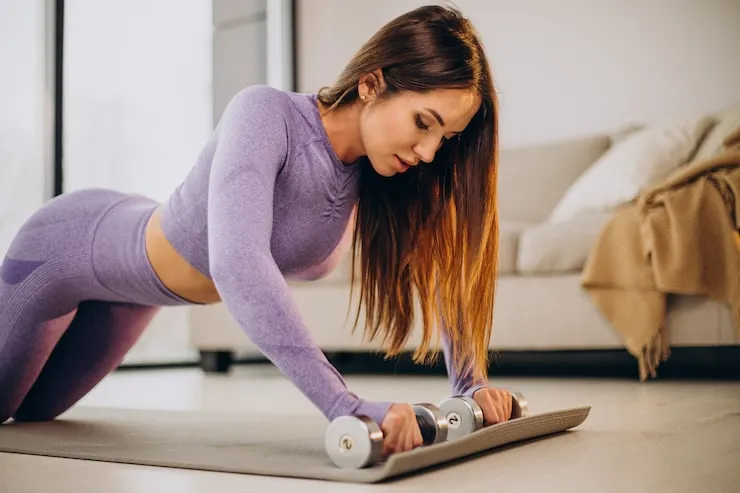
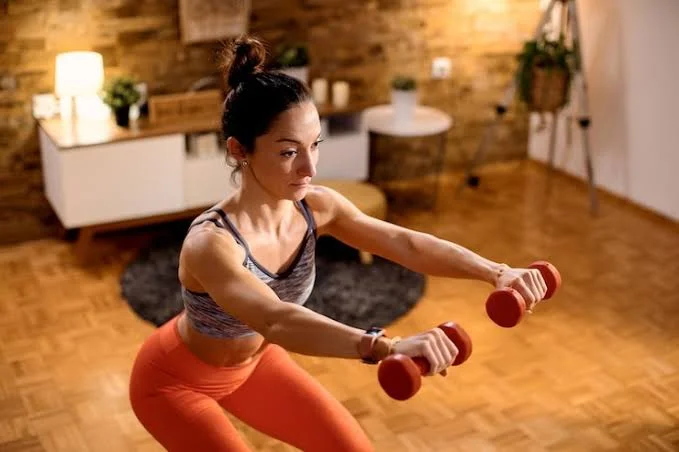
A full body dumbbell workout for beginners is a training routine that uses dumbbells to work every major muscle group in your body during a single session. You perform movements that target your legs, hips, back, chest, shoulders, arms, and core. This type of workout works well for people who are new to strength training because dumbbells are easier to control than barbells and you can adjust the weight as you get stronger.
Most beginners can complete a full body dumbbell workout in about 30 to 45 minutes. You do not need a gym membership or fancy machines. A single pair of dumbbells and a small space in your home is enough to start.
Why Choose Dumbbells for Your First Strength Workout?
Dumbbells offer several advantages for people just starting out. First, they are easy to hold and manage. Unlike a barbell that locks both hands into one position, each dumbbell moves independently. This means your weaker side has to work just as hard as your stronger side, which helps fix muscle imbalances over time.
Second, dumbbells let you adjust the load easily. If an exercise feels too light, you grab a heavier pair. If it feels too heavy, you switch to lighter ones. This flexibility makes it simple to match the weight to your current strength level.
Third, dumbbells take up very little space. A pair of adjustable dumbbells can replace an entire rack of fixed weights. For someone working out in a small apartment or a corner of a room, this matters a lot.
Finally, dumbbell exercises often mirror real-life movements. Picking up a dumbbell from the floor uses the same pattern as picking up a grocery bag. Pressing a dumbbell overhead uses the same pattern as putting a box on a shelf. Training these patterns makes your daily movements easier and safer.
What Muscles Does a Full Body Dumbbell Workout Target?
A well-designed full body routine hits all the major muscle groups. Here is what you work and why it matters:
Legs and glutes. Squats and lunges with dumbbells build strength in your thighs, hips, and buttocks. Strong legs make walking, climbing stairs, and standing up from a chair easier.
Back. Rows and deadlifts work your upper and lower back. A strong back supports good posture and helps prevent everyday aches from sitting too long.
Chest and shoulders. Pressing movements target your chest, shoulders, and triceps. These muscles help you push doors open, carry boxes, and lift things overhead.
Arms. Curls and extensions work your biceps and triceps. You use these muscles every time you carry groceries or lift a suitcase.
Core. Your core stabilizes your body during every exercise. When you hold dumbbells while squatting or standing, your abdominal muscles work hard to keep you balanced.
Read Also: Strength Training For Women Beginners
How to Warm Up Before Your Dumbbell Workout?
Do not skip the warm-up. Cold muscles are more likely to get injured. A proper warm-up raises your body temperature, loosens your joints, and prepares your nervous system for the work ahead.
Spend five to ten minutes on light movement. Here is a simple warm-up you can do without any equipment:
- March in place for one minute. Lift your knees high and swing your arms.
- Arm circles for 30 seconds forward, then 30 seconds backward. Start small and make bigger circles as you go.
- Hip circles for 30 seconds in each direction. Put your hands on your hips and draw big circles with your hips.
- Bodyweight squats for 10 reps. Lower down slowly, then stand back up.
- Cat-cow stretch for 5 reps. On your hands and knees, arch your back up, then let it sag down. Move slowly.
This warm-up takes less than five minutes but makes a real difference in how your workout feels.
The Beginner Full Body Dumbbell Workout
This workout has six exercises. Do them in the order listed. Complete two sets of each exercise. Rest for 45 to 60 seconds between sets.
Start with dumbbells that feel light. You should be able to finish all your reps without your form falling apart. If you can easily do more than the suggested reps, use a heavier pair next time. If you struggle to finish, use lighter ones.
Exercise 1: Goblet Squat
Sets: 2 Reps: 8 to 12
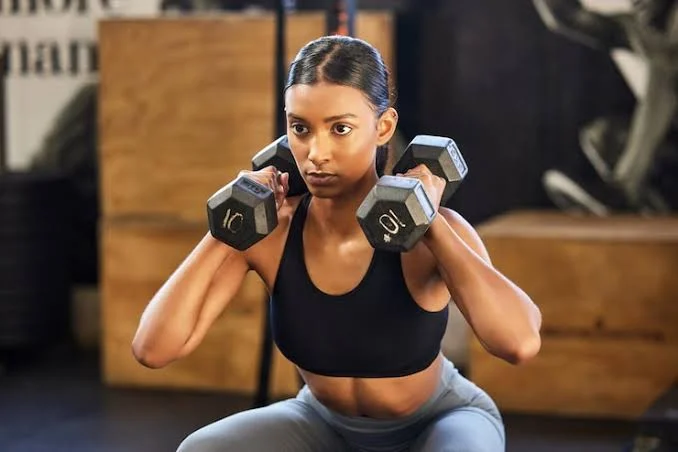
Hold one dumbbell vertically against your chest with both hands. Your feet should be slightly wider than your hips, toes pointed out just a little.
Push your hips back and bend your knees to lower yourself down. Keep your chest up and your back straight. Go as low as you can comfortably go, then push through your feet to stand back up.
This exercise works your thighs, hips, and glutes. It also teaches you the basic squat pattern that you will use in many other exercises.
Common mistake: Letting your knees cave inward. Push your knees out slightly as you lower down.
Exercise 2: Dumbbell Romanian Deadlift
Sets: 2 Reps: 8 to 12
Stand with a dumbbell in each hand, palms facing your thighs. Your feet should be hip-width apart.
With a small bend in your knees, push your hips back and lower the dumbbells toward the floor. Let the weights slide down the front of your legs. Keep your back flat. Stop when you feel a stretch in the back of your thighs.
Squeeze your glutes to stand back up. Do not round your lower back at any point.
This exercise targets your hamstrings, glutes, and lower back. It teaches you how to hinge at the hips, which is one of the most important movement patterns for everyday life.
Common mistake: Squatting down instead of hinging. Think about pushing your butt back toward a wall behind you, not lowering straight down.
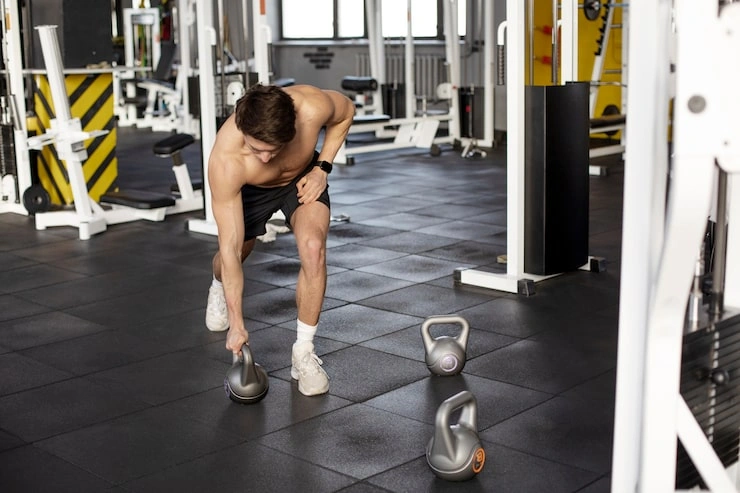
Exercise 3: Dumbbell Bent-Over Row
Sets: 2 Reps: 8 to 12
Hold a dumbbell in each hand. Bend your knees slightly and hinge forward at your hips until your chest is angled toward the floor. Let your arms hang straight down.
Pull the dumbbells up toward your hips. Keep your elbows close to your body. Squeeze your shoulder blades together at the top of the movement. Lower the weights back down with control.
This exercise works your upper back, lats, and biceps. It balances out all the pushing movements and helps improve your posture.
Common mistake: Using momentum to swing the weights up. Move slowly and let your back muscles do the work.
Exercise 4: Dumbbell Floor Press
Sets: 2 Reps: 8 to 12
Lie on your back on the floor with your knees bent. Hold a dumbbell in each hand at chest level, elbows bent.
Press the dumbbells straight up toward the ceiling. Stop just before your elbows lock out. Lower the weights back down until your upper arms touch the floor.
This exercise targets your chest, shoulders, and triceps. Doing it on the floor instead of a bench limits how far your elbows can go down, which protects your shoulders.
Common mistake: Flaring your elbows out too wide. Keep them at about a 45-degree angle from your body.
Exercise 5: Dumbbell Overhead Press
Sets: 2 Reps: 8 to 12
Stand with a dumbbell in each hand at shoulder height, palms facing forward. Brace your core.
Press the weights straight up overhead until your arms are almost straight. Lower them back to shoulder height with control.
This exercise works your shoulders and triceps. It also challenges your core because you have to keep your body stable while pressing weight overhead.
Common mistake: Arching your lower back to help push the weight up. Keep your ribs down and your abs tight.
Exercise 6: Dumbbell Farmer's Carry
Sets: 2 Time: 30 to 45 seconds
Hold a heavy dumbbell in each hand at your sides. Stand tall with your shoulders back.
Walk forward with slow, controlled steps. Keep your core tight and your body upright. Do not let the weights swing.
This exercise works your grip, forearms, core, and shoulders. It also trains your body to stabilize under load, which carries over to many daily activities.
How Much Weight Should Beginners Use?
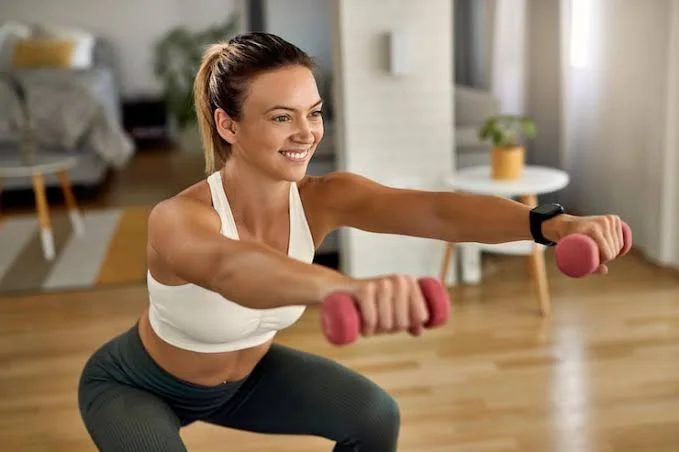
This is the most common question from people starting out. The answer is simple: use a weight that lets you finish all your reps with good form, but leaves you feeling like you could do two or three more reps at the end.
For most beginners, this means:
Women: start with 5 to 10 pound dumbbells for upper body exercises and 10 to 15 pounds for lower body exercises.
Men: start with 10 to 15 pound dumbbells for upper body and 15 to 25 pounds for lower body.
These are starting points, not rules. Some people are naturally stronger and can handle more. Others need to start lighter. What matters is that you pick a weight that challenges you without making you sacrifice form.
Do not worry about what the person next to you is lifting. Focus on your own progress.
How Often Should You Do This Workout?
For beginners, two to three full body dumbbell workouts per week is ideal. This gives your muscles time to recover between sessions.
A good schedule looks like this:
Monday: Full body dumbbell workout
Tuesday: Rest or light activity like walking
Wednesday: Full body dumbbell workout
Thursday: Rest or light activity
Friday: Full body dumbbell workout
Saturday and Sunday: Rest or light activity
Your muscles grow during rest, not during the workout itself. If you train the same muscles hard every day, you will not see good results and you increase your risk of injury.
On your rest days, you do not have to sit completely still. Walking, stretching, or doing light household chores all count as active recovery.
You May Also Like: Low Impact Cardio Workout For Beginners
How to Progress Over Time?
Progressive overload is the principle that you must gradually increase the demands on your muscles to keep getting stronger. If you do the same exercises with the same weight for months, your body will adapt and stop changing.
For beginners, progression can mean several things:
Add reps. If you can do 8 reps easily, work up to 12 reps with the same weight.
Add weight. Once you can do 12 reps with good form, grab a heavier pair of dumbbells.
Add sets. Start with two sets per exercise. After a few weeks, add a third set.
Slow down the lowering phase. Take three seconds to lower the weight instead of one. This makes the exercise harder without adding weight.
Pick one method at a time. Do not change everything at once. Give your body a few weeks to adapt before you make another change.
Common Beginner Mistakes to Avoid
- Using weights that are too heavy. This is the number one mistake. Heavy weights with bad form do not build more muscle. They build injuries. Start lighter than you think you need.
- Holding your breath. Breathe out as you push or pull, and breathe in as you lower the weight. Holding your breath raises your blood pressure and makes you dizzy.
- Skipping the warm-up. Five minutes of warm-up prevents injuries and improves performance. It is not optional.
- Doing too much too soon. You might feel great after your first workout and want to do more. Do not. Soreness often hits a day or two later. Give your body time to recover.
- Ignoring pain. Muscle burn is normal. Sharp pain in a joint is not. If something hurts in a bad way, stop and rest.
- Comparing yourself to others. Your only competition is the person you were yesterday. Focus on your own progress, not someone else's numbers.
Frequently Asked Questions
How long should a beginner dumbbell workout last?
A beginner full body dumbbell workout should last 30 to 45 minutes. This includes your warm-up and cool-down. The main workout portion usually takes 20 to 30 minutes depending on how many sets you do and how long you rest between them.
Can I build muscle with only dumbbells?
Yes. Dumbbells provide enough resistance to build muscle and strength, especially for beginners. Your muscles do not know whether the resistance comes from a dumbbell, a barbell, or a machine. They only know that they have to work against a load. As long as you progressively increase the challenge over time, dumbbells can build real muscle.
What if I do not have dumbbells at home?
You can do many of the same movements with household items. A backpack filled with books or water bottles can work as a substitute for dumbbells. It is not perfect, but it is far better than doing nothing. You can also do bodyweight versions of many exercises like squats, push-ups, and lunges.
Should I do cardio on the same day as my dumbbell workout?
You can, but it is better to separate them if possible. If you must do both on the same day, do your strength workout first. You want to be fresh for lifting so you can use good form. Cardio after strength training is fine.
How do I know if I am using the right weight?
You know the weight is right if you can complete all your reps with good form, but the last two or three reps feel challenging. If you could easily do five more reps, the weight is too light. If you cannot finish the set with good form, the weight is too heavy.
Is it normal to be sore after my first workout?
Yes. Delayed onset muscle soreness, or DOMS, is normal, especially after your first few sessions. It usually peaks one to two days after the workout and fades within a few days. Light movement, hydration, and rest help. If the soreness is severe or lasts more than a week, see a doctor.
Final Thoughts
Starting a strength training routine with dumbbells is one of the best things you can do for your health. You do not need a fancy gym or expensive equipment. You need a pair of dumbbells, a little space, and the willingness to show up a few times a week.
The workout in this guide covers every major muscle group. It takes less than an hour. It works for people who have never lifted a weight before. Start with light dumbbells. Focus on learning the movements correctly. Add weight or reps only when your form is solid.