



I want to be straight with you from the start. If you are reading this, you probably already searched for workout advice before. And what you found probably made you feel worse, not better. Videos of thin people bouncing around. Articles that assume you can just hop off the floor like it's nothing. Plans that use words like "simple" and "easy" but then show exercises your knees simply cannot handle right now.
That stops here.
This is not a polished fitness guide. This is one person talking to another about how to start moving in a body that hurts sometimes, gets tired fast, and has maybe been judged by others at the gym or even by doctors. I am not going to sell you anything. I am not going to promise magical results. I am just going to lay out what works, what does not, and how to begin without breaking yourself in the low impact workout for overweight beginners.
Let us get one thing clear right away. Low impact does not mean sitting in a chair waving your arms and calling it exercise. That is a waste of your time. Low impact simply means your feet stay connected to the ground or your body stays supported so your joints do not take a pounding. No jumping jacks. No burpees. No running in place. None of that nonsense that makes your knees scream after thirty seconds.
You can work hard without impact. You can breathe heavy without impact. You can build real strength without impact. Anyone who tells you otherwise does not understand how bodies like ours actually function.
I know these things. That is why what I am about to share is different.
First Things First: You Need a Chair and a Bit of Floor
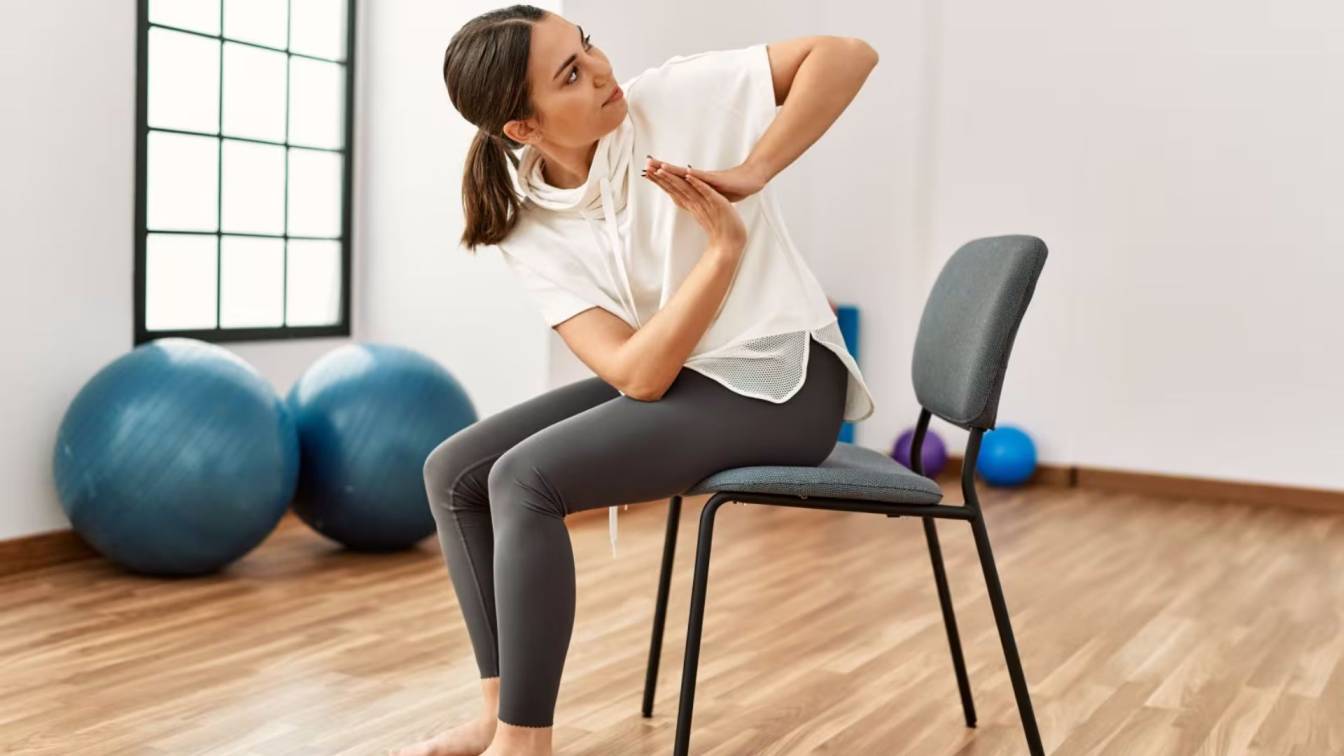
That is your equipment. A sturdy chair. One that does not have wheels. One that can hold your weight without wobbling. If you do not own one, get one. A basic wooden dining chair works. Nothing fancy.
You also need a small clear space. About the size of a yoga mat. If you do not have a mat, a carpeted area or a towel on a hard floor works fine.
Shoes are optional. Barefoot on carpet is fine. Socks on hardwood can be slippery, so be careful there. Wear whatever clothes let you breathe and move without fighting the fabric.
That is all you need. No gym membership. No expensive equipment. No special clothing. You can start today in your living room while dinner cooks or early in the morning before anyone else wakes up.
Read Also: Fat Burning Workout For Remote Employees
Before You Move a Single Muscle
Sit in your chair for a moment. Feet flat. Hands on your thighs. Close your eyes if you want. Take three slow breaths. Not dramatic deep breathing. Just normal breaths but a little slower on the way out.
Notice how your body actually feels right now. Is your lower back tight? Are your knees achy? Is your neck stiff from looking at a phone? This matters because you are about to move this body. You should know what it feels like before you start so you can tell what changed after.
This is not meditation. This is not some spiritual practice. This is simply checking in with yourself before asking your body to do work. Mechanics check the engine before a long drive. You are checking your joints before exercise. Same idea.
The Warm Up That Actually Prepares You
Skip this part and you will regret it. A cold muscle tears easier than a warm one. A stiff joint gets angry when you ask it to move without warning. Five minutes here saves you days of soreness later.
First Movement: Seated Leg Lifts
Stay in your chair. Lift your right foot off the floor just a few inches. Hold it there for a slow count of three. Lower it back down slowly, not dropping it. Now left foot. Alternate like this for about a minute. Your thighs will feel a slight burn. That is blood arriving at the muscles. Exactly what you want.
Second Movement: Slow Shoulder Rolls
Sit up a little taller. Bring your shoulders up toward your ears, then roll them back and down. Big circles. Do this five times. Then reverse direction for five more. If you hear crunching or popping, that is normal unless it hurts. Joints make noise sometimes.
Third Movement: Wrist and Ankle Circles
Lift one hand and draw circles with your wrist. Tiny ones, then bigger ones. Do the other wrist. Then do the same with your ankles, one at a time. This wakes up all the small joints that tend to get ignored until they hurt.
Fourth Movement: Gentle Spine Twist
Still seated. Cross your arms over your chest. Keep your hips facing forward. Turn your upper body to look behind you on the right. Go only as far as comfortable. Come back to center. Now left. Do this four times each side. Your spine will crackle maybe. Normal. If there is sharp pain, stop and just do half the range.
That is your warm up. Roughly five minutes. Your body temperature is slightly up. Blood is flowing. Joints are lubricated. Now you can do the actual work without your body fighting you.
The Five Exercises That Build Your Foundation
These are not random exercises I pulled from a list. Each one has a purpose that connects to real life. Getting out of a chair. Pushing open a door. Walking without getting winded. These movements build strength you will use every single day.
Chair Squats: For Getting Up and Down From Things
Stand with your back to the chair. The seat should touch the back of your legs. Your feet are about as wide as your hips. Not together. Not super wide. Just comfortable.
Now bend your knees and lower your backside toward the chair. Go slow. Control the descent. Do not just flop down. Lightly tap the seat with your bottom, then push through your heels and stand back up.
If you cannot control the descent yet, that is fine. Sit down fully on the chair. Pause. Then stand up without using your hands. That is still a squat. That still counts. Over time, work toward just tapping the seat instead of sitting completely.
Your knees should track over your toes, not cave inward. If they cave in, widen your stance a bit or push your knees outward on purpose as you stand. Think of spreading the floor apart with your feet.
Do ten of these. If ten is too much, do five. If five is too much, do three. The exact number does not matter right now. What matters is you do them with control and stop before your form falls apart.
Wall Push Ups: For Upper Body Strength Without the Floor
Facing a wall. Stand about an arm's length away. Place your palms flat on the wall at shoulder height. Your fingers pointing up. Your hands a little wider than your shoulders.
Keep your body straight. Do not let your hips sag or your back arch. You want a plank position but standing up.
Bend your elbows and bring your chest toward the wall. Your elbows should angle out to the sides, not flare straight out. Go as deep as comfortable. Push back to start.
This is not a fake push up. This is a real exercise that builds actual strength in your chest, shoulders, and the backs of your arms. When wall push ups become easy, you move to a counter. Then a table. Then eventually the floor. That progression takes months sometimes. That is fine. No rush.
Do ten. Same rule applies. If ten is too many, do less. Control matters more than count.
Standing Marches: For Your Heart and Lungs
Stand next to your chair. Hold the back of it lightly for balance if you need to. If you do not need the support, let your arms swing naturally.
Lift your right knee. Not high. Just enough that your foot leaves the floor. Lower it. Lift your left knee. Alternate at a rhythm that feels like a comfortable walk.
Do not speed up. Do not slow down so much you barely move. Find a pace where you could talk to someone without gasping but would struggle to sing a song. That middle zone is where your heart and lungs get stronger.
Keep this going for two minutes. If two minutes feels impossible, start with one. If one minute feels impossible, start with thirty seconds. Build up slowly. Add fifteen seconds each week.
The goal is not to exhaust yourself. The goal is to finish the time and feel like you could maybe do a little more. That feeling tells you the work was right for your current fitness level.
You May Also Like: Benefits Of Morning Workout Vs Evening For Men
Seated Back Rows: For the Muscles That Hold You Upright
This one needs a resistance band if you have one. A light band. Nothing heavy. If you do not have a band, skip this for now. You can do it later when you get one. A basic set of bands costs less than fifteen dollars online or at most stores.
Sit in your chair. Loop the band around something sturdy in front of you. A heavy table leg. A door anchor. Even your own feet if you can hold the band ends and press your feet against it.
Hold the band ends in each hand. Palms facing each other or facing down, either way works. Sit tall. Pull the band toward your lower ribs, squeezing your shoulder blades together as you pull. Do not shrug your shoulders up to your ears. Keep the low impact workout for overweight beginners.
Slowly release back to start. That is one rep.
This works the muscles between your shoulder blades and in your upper back. These muscles get weak from sitting and slouching. Strengthening them helps you stand taller and reduces that nagging ache between your shoulders.
Do twelve. Bands make the movement harder at the end, so the last few should feel challenging but not painful.
Lying Leg Lifts: For Your Core Without Crunching Your Neck
This is the one floor exercise in the routine. If getting on the floor is difficult, you can do this on a firm bed or skip it entirely. You still get a good workout from the other four.
Lie on your back on a mat or carpet. Your legs straight out. Your arms by your sides or hands placed under your lower back if you need extra support there.
This hits the lower part of your core. The part that supports your lower back. A stronger core often means less back pain day to day.
Do ten. Breathe normally throughout. Do not hold your breath. Exhale as you lift, inhale as you lower.
The Whole Routine at a Glance
Here is the order with rest between each exercise.
- Chair squats, ten reps, rest one minute
- Wall push ups, ten reps, rest one minute
- Standing marches, two minutes, rest one minute
- Seated back rows, twelve reps, rest one minute
- Lying leg lifts, ten reps, rest one minute
That whole thing takes roughly twenty minutes including rests. Maybe twenty five if you are moving slow and taking your time, which you should.
Do this on Monday, Wednesday, and Friday. Or Tuesday, Thursday, Saturday. Pick three days that are not back to back. Your body needs the off days to repair.
The Cool Down You Actually Need
Just like the warm up, this part matters. Stopping suddenly after working out can make you dizzy. Your blood pools in your legs if you just sit down immediately. A few minutes of winding down prevents that and reduces stiffness tomorrow.
Hamstring Stretch From the Chair
Sit on the edge of your chair. Extend your right leg straight out, heel on the floor, toes pointing up. Keep your left foot flat. Sit tall. Gently lean forward from your hips, not your low back. You will feel a pull down the back of your right thigh. Hold twenty seconds. Switch legs.
Chest Stretch in a Doorway
Find a doorway. Place your right forearm against the doorframe at shoulder height. Step your right foot forward gently. You will feel a stretch across the front of your right shoulder and chest. Hold fifteen seconds. Switch sides.
Standing Quad Stretch
Stand next to your chair. Hold it with your left hand. Bend your right knee. Reach back with your right hand and grab your pant leg or ankle. Pull gently until you feel a stretch in the front of your right thigh. Keep your knees close together. Hold twenty seconds. Switch sides.
Neck Release
Sit or stand. Drop your right ear toward your right shoulder. Do not force it. Place your right hand lightly on the left side of your head for a gentle extra pull if you want. Hold fifteen seconds. Switch sides.
That is your cool down. Five minutes. Done. Now go drink some water.
What About Soreness?
Your muscles will probably be sore the day after your first workout. Maybe the second day too. This is normal. It is called delayed onset muscle soreness. It means your muscles did work they are not used to. It does not mean you are injured.
Soreness feels like a dull ache spread across a muscle. Injury feels sharp and specific. If you feel sharp pain in a joint or a tendon, that is not soreness. That is a problem. Stop the movement that caused it and let that area rest.
For normal soreness, gentle movement actually helps. A short walk. Some light stretching. Warm water from a bath or shower. These all increase blood flow and help the ache fade faster.
Do not take painkillers just to push through a workout. That masks pain you need to feel. Pain is information. Listen to it.
How to Keep Going When You Do Not Want To?
Some days you will not want to work out. That is just reality. Motivation is a temporary visitor. It shows up, stays a while, and leaves without warning. You cannot rely on motivation alone.
What you need is a low bar. On days when motivation is gone, tell yourself you only have to do the warm up. That is it. Five minutes of seated movement and then you are allowed to stop. No guilt.
Here is what usually happens. You do the warm up. You are already in your workout clothes. You are already in the space. The chair is already there. And you think, well I am here anyway, might as well do a few squats. And then you do a few. And then you do the whole workout.
The hard part is always starting. Once you start, momentum carries you forward. But you have to lower the barrier to starting. Telling yourself you have to do the full twenty minute workout every time makes starting feel heavy. Telling yourself you only have to do five minutes makes starting feel light.
If you do the warm up and still do not want to continue, genuinely stop. You kept the habit alive by showing up. The habit is the valuable thing. The individual workout is secondary.
What Results to Actually Expect?
If you follow this routine three days a week for a month, here is what will likely happen.
Your legs will feel steadier. Getting up from low chairs or car seats will require less effort. You might notice you do not have to rock forward to stand up anymore.
Your stamina will improve slightly. The two minute march will feel easier. Walking to the mailbox or around a store will leave you less winded.
Your back might ache less. The core and back strengthening work, combined with simply moving more, often reduces that nagging low back tightness.
Your mood might lift. Not dramatically like a movie montage. But a quiet improvement. A little more patience. A little less irritation at small things. Movement does that to the brain.
You might not lose weight. I need to be honest about this. Three days of twenty minute workouts will not melt off pounds. Weight loss is mostly about food, not exercise. What the exercise does is build the foundation. The strength. The stamina. The routine. You can add dietary changes later or alongside. But do not expect the scale to move just from these workouts alone.
Final Thoughts That Matter
If you read all of this, thank you. If you skimmed to the bottom, that is fine too. Here is what I want you to take away.
You can start today. Right now. In whatever you are wearing. In whatever condition your body is in. You do not need to get ready to start. Starting is what gets you ready.
Do not compare your chapter one to someone else's chapter twenty. The people doing intense workouts have been at this for years sometimes. You are on day one. Or week one. Different stage entirely.
Your body is not broken. It is not a problem to fix. It is a body that has carried you this far and deserves care, not punishment. Movement is care. Food is care. Rest is care.
If you do the warm up today and nothing else, you won. You started. Tomorrow you do a little more. Or the same amount. It does not matter. What matters is you keep coming back.
You deserve to feel good in your body. Not when you hit some goal weight. Not when you look a certain way. Now. Today. In this body you have right this moment.